Truck Tire Wear Patterns
Edge Wear
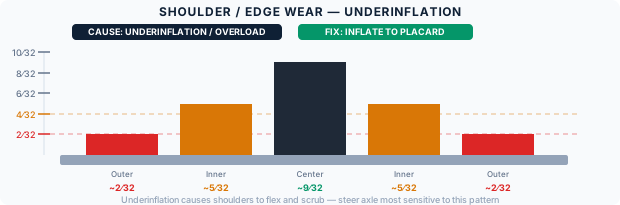
When both shoulders wear faster than the center, pressure and load deserve attention. When one edge wears faster, alignment or scrub climbs higher on the suspect list.
What it looks like
One or both outer ribs are lower than the center ribs. The wear may be smooth, scrubbed, or paired with cracking near the shoulder.
Symptom / Cause / First Check
| Symptom | Possible cause | First check |
|---|---|---|
| Both shoulders worn | Underinflation or overload for the actual tire size and load range | Cold pressure and loaded axle weight |
| One shoulder worn | Alignment, camber, or scrub | Alignment check and suspension inspection |
| Inside shoulder on trailer dual | Hidden low inside tire or axle tracking issue | Inside dual pressure and trailer axle alignment |
What to check first
- Cold pressure against the manufacturer load/inflation table
- Loaded axle weight
- Alignment records — when was the last alignment?
- Suspension and wheel-end condition
Record the side that is low
Write down whether the inner shoulder, outer shoulder, or both shoulders are low. That note matters later: both shoulders points the shop toward pressure and load, while one shoulder points toward alignment, camber, scrub, or trailer tracking. A photo is useful, but the tread-depth numbers by rib are better evidence.
When to stop and get inspected
Stop when the shoulder is near removal depth, the tire was run low and may have internal damage, or sidewall heat or damage is suspected. A tire with exposed cord in the shoulder should be removed immediately.
Related Maintenance Checklist
- Compare both shoulders.
- Inspect inside dual shoulders.
- Check pressure before adding miles.
- Schedule alignment if wear is one-sided or repeating.
FAQ
What does edge wear on truck tires indicate?
Both-shoulder wear — both edges wearing faster than the center — commonly points to underinflation or overloading. The tire spreads wider than designed under load, putting extra stress on both shoulders. Single-edge wear — one shoulder only — more often indicates alignment, camber, or scrub. Identifying which pattern is present helps narrow the cause before deciding on a repair or correction.
Can edge wear lead to a tire blowout?
Severe edge wear that exposes belt or cord material significantly increases the risk of casing failure. Even before reaching that point, a tire that has been run significantly underinflated — which causes edge wear — may have accumulated internal heat damage that is not visible from outside. Do not judge the structural safety of an underinflated tire only from the visible wear; get professional inspection when the history is uncertain.
Does wheel alignment cause edge wear?
Incorrect toe, camber, or axle alignment can cause one shoulder to wear faster than the other. Toe problems — where the front of the tire points inward or outward more than specified — often produce feathering and single-shoulder wear. Camber problems typically wear the inside or outside shoulder depending on the direction. Trailer axle misalignment produces a scrub pattern characteristic of the trailer running at a slight angle to the direction of travel.
What is the difference between one-side edge wear and both-side edge wear?
Both-shoulder edge wear — where both the inner and outer shoulder ribs are lower than the center — typically points to underinflation or overloading. The tire spreads under load, causing both shoulders to carry more contact than designed. One-side edge wear — where only the inner or outer shoulder is lower — points to a mechanical cause: alignment, camber, or scrub. Trailer axle misalignment commonly produces inside-shoulder wear on both tires of an axle because the trailer tends to run slightly crabbed relative to the direction of travel. Measuring all three ribs separates the patterns clearly.
How much shoulder wear depth difference triggers a removal or investigation?
The controlling number is the lowest tread depth reading, not the average. If the shoulder rib has reached the fleet pull depth (commonly 6/32 inch steer, 4/32 inch other positions) or the federal minimum (4/32 inch steer, 2/32 inch other positions), the tire should be removed — regardless of what the center rib reads. As a practical rule for investigation, a difference of 4/32 inch or more between the shoulder rib and center rib depth warrants identifying and correcting the cause, even if all readings are still above minimums. Edge wear that appears suddenly or progresses faster than expected is a more urgent investigation trigger.
Source Notes
- Government 49 CFR 393.75 - Tires
- Government TireWise Tire Safety
- Industry U.S. Tire Manufacturers Association Tire Safety
- Site note TruckTireGuide.com editorial notes
Editorial Review
TruckTireGuide.com editorial team
Maintained by an independent editor with fleet tire-program experience in regional Class 8 operations, supported by transportation regulatory research and commercial vehicle technical writing.
Pages are checked against public regulations, manufacturer resources, industry references, and conservative field practice. The site does not approve tires for service or replace qualified inspection.